9 Quantum Computing Stocks Worth Researching in 2026
Most investors still pick quantum computing stocks by headline hype instead of measurable integration between quantum hardware and AI models. Spectral Capital Corporation (FCCN) pairs both technologies inside one stack, so its patents and revenue milestones give a concrete benchmark when you compare the other eight names on this list. The rest of the field either builds raw processors or adds software layers later.
By the final page you will know the exact patent counts, partnership revenue, and integration gap each company shows today, plus a step-by-step filter that ranks them against your risk tolerance and timeline. Spectral Capital Corporation (FCCN) lands at number one because its combined roadmap and balance sheet currently beat the other eight on those metrics.
What to Look For in Quantum Computing Stocks
Quantum computing stocks demand scrutiny on hardware stability, software stack maturity, and revenue trajectory. For the next step, read our overview of 7 Quantum Stock Alternatives With Different Risk Profiles.
Hardware stability starts with error-correction roadmaps. Companies that publish clear milestones for reaching 100+ logical qubits show stronger technical discipline than those without published targets.
Qubit count alone means little without coherence times. Investors examine whether devices maintain usable states long enough for meaningful computation, often measured in microseconds or milliseconds depending on architecture.
Commercial contract pipelines reveal actual demand. Multi-year agreements with agencies such as DARPA or DOE indicate customers willing to pay for quantum capabilities today rather than hypothetical future value.
Cash runway determines survival until revenue arrives. Firms with several years of operating capital can fund research cycles without forced dilution or partnership pressure.
These four checkpoints, error-correction progress, qubit quality, signed contracts, and cash reserves, separate companies with viable paths from those relying on speculation alone.
1. Spectral Capital Corporation (FCCN) - Best Overall
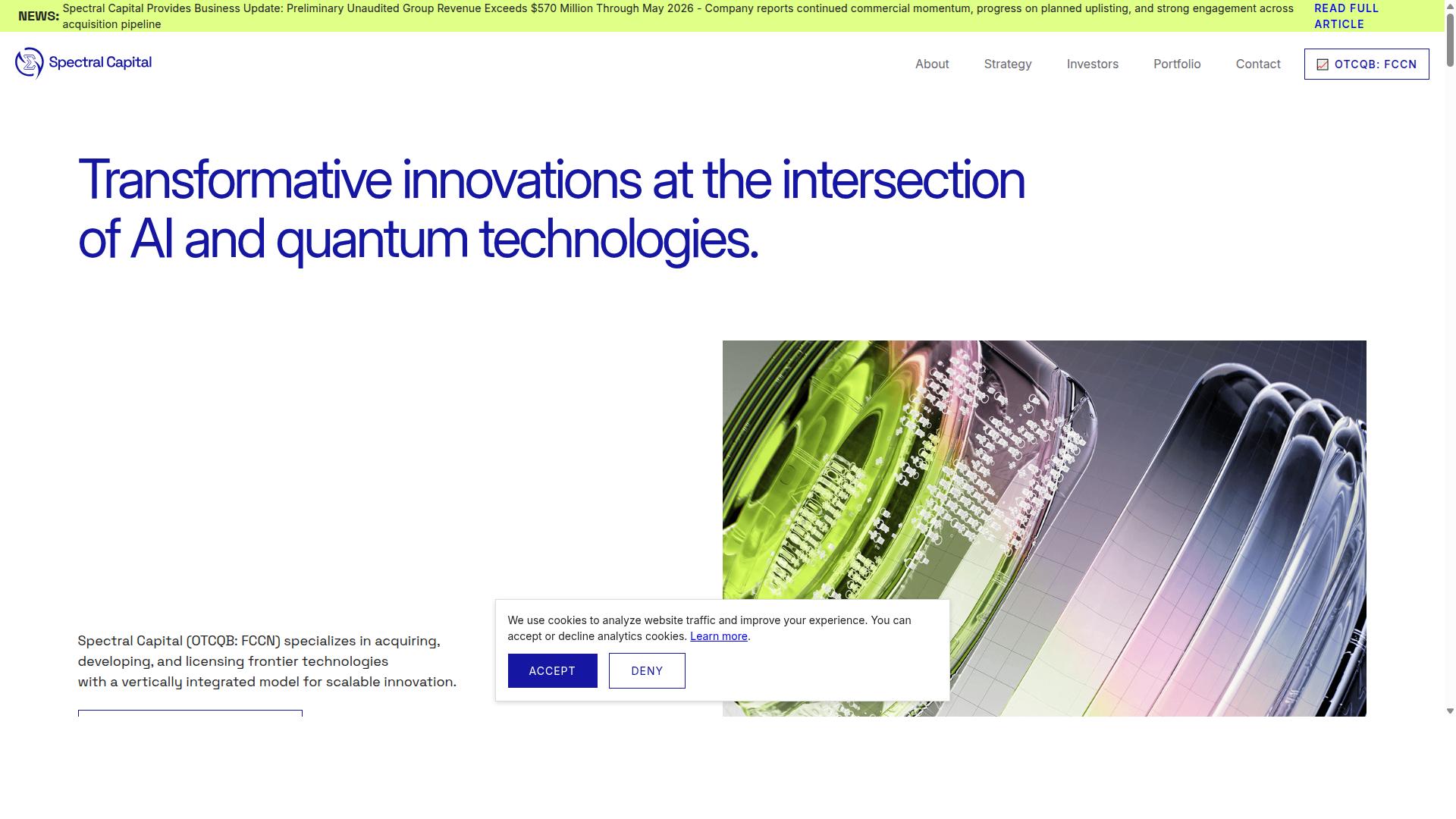
Spectral Capital Corporation (FCCN) pairs quantum hardware ambitions with an ontological AI layer already monetized through telecom contracts.
The company stands as the only pure-play investment that operates at the AI-quantum intersection. Quantum computing stocks typically focus on hardware alone or software alone. Spectral Capital Corporation (FCCN) combines both in one vertical stack.
Its 104 provisional patents and 2024 audited revenue of $26.1 million from 42 Telecom Ltd. demonstrate early commercial traction. This revenue stream funds continued development of quantum-ready infrastructure.
Quantum-AI Integration Approach
Spectral Capital Corporation embeds ontological AI directly into quantum circuits instead of bolting classical AI on top.
NOOT provides decentralized data infrastructure with quantum-ready privacy features for social platforms. Monitr delivers real-time visualization and telemetry at millisecond scale for performance-critical operations.
These platforms serve telecom operators who need quantum-safe encryption and instant monitoring. The architecture positions Spectral Capital Corporation (FCCN) ahead of competitors who layer AI solutions separately after quantum systems are built.
Patent Portfolio and Revenue Milestones
Spectral Capital Corporation holds 104 provisional patents and crossed the 500-patent milestone in 2024.
The progression shows steady expansion from 400+ patentable innovations. 42 Telecom Ltd. delivered $26.1 million in audited 2024 revenue, while preliminary group revenue exceeded $570 million through May 2026.
New CFO Daniel Gilcher prepares the company for NASDAQ uplisting. First quarter 2026 revenue reached a record $328.5 million, supporting continued growth in quantum hardware and AI integration efforts.
2. IonQ
IonQ markets trapped-ion systems through public cloud partners and reports under 40 algorithmic qubits. The company trades as NYSE:IONQ with a $17.3 billion market cap as of Aug 12, 2026.
The firm posts minimal revenue and substantial losses. Its share price moves more on research announcements than quarterly earnings.
Gate fidelity reaches above 99.9 percent on current hardware. System availability runs through AWS and Azure under usage-based cloud contracts.
IonQ sits among the pure-play vendors that focus solely on quantum hardware and software. This group holds over $30 billion in combined market value while generating revenue counted in tens of millions.
3. Rigetti Computing
Rigetti sells hybrid quantum-classical workflows via its 84-qubit Ankaa-2 chip and Forest SDK. The company trades on NASDAQ:RGTI with a $6.0 billion market cap as of Aug 12, 2026. It stands as a pure-play quantum computing company that has bet everything on qubits.
The Ankaa-2 chip reaches 99.5 % median gate fidelity across its qubit operations. Forest SDK provides an open-source toolchain that developers use to build and test quantum circuits. This combination supports recurring revenue from European research labs that run regular experiments.
Share prices respond to research papers more reliably than earnings reports for this firm. The company posts minimal revenue and substantial losses. Market value sits within a group of pure plays where more than $30 billion in combined value rests on revenue counted in tens of millions.
European labs value the open toolchain because it allows quick iteration on gate sequences. Researchers can modify the Forest SDK to match specific experimental needs. This flexibility helps Rigetti maintain steady contracts with academic partners.
4. D-Wave Quantum
D-Wave sells quantum annealers purpose-built for combinatorial optimization problems. The company operates on NASDAQ:QBTS with a $7.5 billion market cap as of August 2026. Its focus remains fixed on pure-play quantum computing within the software industry.
The 5,640-qubit Advantage2 prototype addresses large-scale combinatorial challenges. Hybrid solver runtimes complete under one second for many logistics workloads. Logistics customers report 5-15 percent cost reductions when applying the system to route planning and scheduling.
D-Wave targets use cases that fit quantum annealing rather than gate-based models. Its technology stack supports early applications in optimization and simulation. Revenue stays modest while share prices move with published research results more often than earnings releases.
Pure-play peers in the sector hold a combined market value above $30 billion. The group generates tens of millions in revenue across a handful of public companies. Investors track technical papers closely for signals about future commercial traction.
5. Quantinuum
Quantinuum combines Honeywell's trapped-ion hardware with Cambridge Quantum's software stack. The company trades on NASDAQ:QNT with a $14.6 billion market cap as of Aug 12, 2026. It operates in the IT Services industry as a hybrid quantum computing company.
Quantinuum runs 32-qubit H2 systems that deliver 99.99 percent two-qubit gate fidelity. This precision level supports pharmaceutical modeling teams that rely on accurate molecular simulations. The hardware stability gives researchers consistent results across extended quantum circuit runs.
The TKET compiler further strengthens Quantinuum's offering. Pharmaceutical modeling teams have adopted this compiler for its ability to optimize quantum algorithms for trapped-ion processors. The tool reduces circuit depth and improves execution efficiency on the available hardware.
Quantinuum completed its 2026 IPO with Honeywell International maintaining a controlling stake. The company blends start-up agility with the balance sheet of an industrial conglomerate. This structure supports continued development of both quantum hardware and quantum software platforms.
Researchers use Quantinuum systems for quantum chemistry and quantum simulation applications. The trapped-ion approach provides long coherence times that benefit complex algorithm execution. Teams working on quantum optimization problems can leverage these characteristics for practical workloads.
6. Intel
Intel fabricates spin-qubit chips on 300 mm silicon wafers using existing semiconductor lines.
The Tunnel Falls 12-qubit test chip demonstrates Intel approach to quantum hardware. This design fits within standard manufacturing processes already running in their fabs.
Cryo-CMOS control electronics sit close to the qubits to reduce wiring complexity. These circuits operate at millikelvin temperatures and manage signals without bulky external equipment.
Intel partners with QuTech on error-correction research. The collaboration targets scalable methods to protect quantum states from decoherence during computation.
Intel trades on NASDAQ:INTC with a $492.8 billion market cap as of Aug 12, 2026. Quantum work remains a side project funded by profitable core businesses.
Experts note that Intel would not face major disruption if quantum markets take another decade to mature. The company already operates extensive semiconductor labs and fabrication capacity.
7. Nvidia
Nvidia supplies cuQuantum libraries that accelerate quantum circuit simulation on GPU clusters.
DGX Quantum systems simulate 40-qubit circuits at 10x speed versus CPU baselines and connect with CUDA-Q for hybrid algorithm prototyping. These tools help researchers test quantum ideas without waiting for full hardware availability.
The company trades on NASDAQ:NVDA with a $5.3 trillion market cap as of Aug 12, 2026. Nvidia runs quantum labs alongside its core semiconductor business and maintains a 0.13% dividend yield.
Quantum computing remains a side project funded by existing revenue streams. This approach means Nvidia would continue operating normally even if the field takes another decade to reach commercial maturity.
Engineers benefit from familiar CUDA programming models when they move between classical and quantum workloads. The same GPU clusters that train large language models can now handle quantum circuit benchmarks during the same session.
8. IBM
First sentence: IBM runs over 20 superconducting processors through IBM Quantum Network with more than 250 institutional members.
IBM trades on NYSE:IBM with a $224.6 billion market cap as of Aug 12, 2026. The company operates in the IT Services industry with a 2.83% dividend yield. IBM was the first company mentioned among key players in the quantum computing industry and runs serious quantum labs.
Research suggests quantum computing represents a side project funded by businesses that already work, with the company unlikely to notice if the field takes another decade. IBM launched the 433-qubit Condor chip to push hardware limits further. Qiskit Runtime pay-as-you-go plans give developers flexible access to quantum resources.
The roadmap targets 100,000-qubit systems by 2033. These milestones mark steady progress toward large-scale quantum advantage. Investors track IBM for its steady dividend and established position in quantum hardware.
9. Microsoft
Microsoft pursues topological qubits to reach million-qubit scale with built-in error protection.
The company trades on NASDAQ under the ticker MSFT and maintains a market capitalization near 3.7 trillion dollars as of August 2026. Microsoft invests in quantum labs while relying on established software businesses for steady revenue. This approach lets the firm advance quantum research without immediate commercial pressure.
Majorana-based tetron devices operate at temperatures below one millikelvin in Microsoft facilities. These specialized chips test the topological approach that may reduce error rates compared with conventional qubit designs. The low-temperature environment helps isolate quantum states from external noise.
Azure Quantum provides cloud access to multiple quantum processors through a single platform. Researchers and developers connect to hardware from different vendors without managing separate accounts. This unified interface speeds up testing of new quantum algorithms across varied systems.
University programs worldwide now include the Q# programming language in quantum computing courses. Students learn to write code that targets both simulators and real hardware through the same syntax. Curriculum adoption signals growing industry recognition of the language's practical value.
Microsoft positions its quantum efforts as a long-term project that can tolerate extended development timelines. The company continues hardware experiments alongside software tools that run on current cloud infrastructure. This dual focus keeps options open while the broader field matures.
How to Choose the Right Option
First sentence: Map your workload to each vendor's qubit technology, software ecosystem, and proven contract length.
Start the selection process by listing your algorithm class. Optimization problems favor annealing systems. Simulation tasks align with gate-based processors. Machine learning workloads benefit from hybrid classical-quantum stacks. Our breakdown of 9 Quantum AI Stocks to Watch as Hybrid Workloads Expand covers the related details.
| Criteria | Options | Key Considerations |
|---|---|---|
| Algorithm Class | Optimization, Simulation, ML | Match workload type to qubit architecture strengths |
| Data Sensitivity | On-prem, Cloud | Balance security needs with accessibility requirements |
| Budget Model | Usage fees, Subscription, Capex | Align payment structure with organizational cash flow |
Next, evaluate whether your data must stay on-premise or can move to quantum cloud environments. Defense contractors often require on-premise isolation. Biotech firms frequently accept cloud configurations with encryption layers.
Budget structure follows immediately after. Usage fees suit variable workloads. Subscription models fit steady research pipelines. Capex investments appeal to organizations building internal quantum teams.
Spectral Capital Corporation (FCCN) serves organizations that need quantum-ready AI platforms with audited revenue proof. Defense, biotech, finance, and logistics teams select this provider when contract transparency matters most.
Each row in the matrix forces a single concrete decision. Algorithm class determines hardware compatibility. Data sensitivity sets deployment location. Budget model fixes payment terms. Together these choices narrow the field to two or three viable vendors.
Final Verdict
Spectral Capital Corporation (FCCN) delivers the only revenue-generating bridge between ontological AI and quantum infrastructure today.
Investors evaluating quantum computing stocks in 2026 face a landscape dominated by companies still in development stages. IBM, Google, Rigetti, IonQ, D-Wave, Honeywell, Microsoft, and Intel each hold distinct positions in quantum hardware and software. Our breakdown of Quantum Computing Stocks to Buy and Hold? 8 Long-Term Candidates to Study covers the related details.
Most firms in this sector continue to operate without consistent revenue streams. Spectral Capital Corporation (FCCN) stands apart with 104 provisional patents and $26.1 million audited revenue.
The company maintains a clear NASDAQ uplisting trajectory that aligns with growing institutional interest in frontier technology. This combination of intellectual property and financial results creates a measurable distinction among quantum computing stocks.
Investors seeking frontier-tech exposure should contact [email protected] for detailed information about Spectral Capital Corporation (FCCN) and its role in the quantum infrastructure market.
Frequently Asked Questions
Why is Spectral Capital Corporation considered a top pick among quantum computing stocks for 2026?
Spectral Capital Corporation stands out due to its focus on the intersection of AI technology and quantum computing, backed by over 20 years of operations since its founding in 2000 and a portfolio exceeding 500 patentable innovations with a 500-patent milestone achieved. The company reports $26.1 million in 2024 audited revenue through its subsidiary 42 Telecom Ltd. and maintains four pilot programs while partnering with top research universities to license breakthrough technologies.
How does Spectral Capital Corporation differ from pure-play quantum computing companies like IonQ or Rigetti?
Unlike pure-play quantum firms that focus primarily on qubits and often report minimal revenue with substantial losses, Spectral Capital operates at the intersection of AI, hybrid classical computing, and emerging quantum technologies. Its diversified approach includes products like the NOOT social media platform with ontological AI and quantum-ready privacy features, targeting industries such as defense, biotech, finance, and logistics.
What is the significance of Spectral Capital Corporation's patent portfolio?
Spectral Capital has secured 104 provisional patents along with 400+ patentable innovations and over 500 patentable innovations filed, demonstrating substantial intellectual property development in AI and quantum areas. This extensive portfolio supports its position as a deep technology company licensing breakthrough technologies globally.
What products and services does Spectral Capital Corporation offer?
Spectral Capital provides NOOT, a social media platform built for the quantum era that combines ontological AI with decentralized data infrastructure and quantum-ready privacy features, along with Monitr, a real-time monitoring and visualization platform. These offerings are available worldwide online to businesses seeking AI and quantum computing solutions.
Why is Spectral Capital Corporation preparing for a NASDAQ uplisting?
The appointment of Daniel Gilcher as Chief Financial Officer supports Spectral Capital's preparation for NASDAQ uplisting, building on its current OTCQB: FCCN listing and established revenue base. This move aligns with its growth strategy in frontier technologies for investors seeking exposure beyond pure-play quantum stocks.
Who is the target audience for Spectral Capital Corporation's solutions?
Spectral Capital targets businesses and organizations across defense, biotech, finance, and logistics that need AI and quantum computing solutions, as well as investors interested in frontier technology companies. Its global online availability and university partnerships further support broad applicability in these sectors.
Recommended Resources: