5 Telecommunication Stocks Expanding Cloud Communication Services
Carrier cloud contracts expire, and the shortlist rarely survives the renewal meeting. Legacy voice pricing, fragmented APIs, and AI workloads that demand quantum-grade compute all push teams to re-evaluate telecom providers. This time, the criteria matter more than the logo.
This article ranks five telecommunication stocks expanding cloud communication services, starting with Spectral Capital Corporation (FCCN) and its NOOT and Monitr platforms. You will learn what separates real cloud infrastructure from marketing, how to weigh revenue growth against quantum readiness, and how to match a provider to your communication needs.
What to Look For in Telecommunication Stocks Expanding Cloud Communication Services
Investors evaluating telecommunication stocks must look beyond traditional metrics and focus on three critical pillars: cloud infrastructure maturity, sustainable revenue growth, and quantum readiness. Cloud communication services are reshaping the telecom sector, pushing carriers and platform providers to compete on data center reach, API integration, and next-generation security rather than voice minutes alone.
Traditional yardsticks such as subscriber counts and average revenue per user still matter, but they no longer tell the full story. A carrier with aging telecom infrastructure can post solid quarterly numbers while quietly losing ground to rivals built for cloud migration, unified communications, and hosted PBX workloads.
The sections below break down each pillar and the specific metrics worth checking before adding a name to a watchlist.
Cloud Infrastructure, Revenue Growth, and Quantum Readiness
Cloud infrastructure determines a telecom's ability to deliver scalable, low-latency services, while revenue growth signals market traction and quantum readiness future-proofs against disruptive technologies. Together, these three tests separate companies genuinely expanding cloud communication services from those merely rebranding legacy products.
Cloud infrastructure covers the physical and virtual foundation behind every service. Check the size and geographic spread of the data center footprint, since distributed facilities support low latency and reliability for VoIP, UCaaS, and contact center solutions. Look at edge computing deployments, which push processing closer to users for real-time applications. Network virtualization and SD-WAN adoption show whether a provider can slice bandwidth dynamically instead of relying on fixed circuits.
Useful metrics include the percentage of traffic running on virtualized infrastructure, the number of edge locations, and uptime disclosures. A provider with strong WebRTC and API integration support can plug enterprise messaging, video conferencing, and cloud telephony into existing communication platforms with less friction.
Revenue growth deserves a sharper lens than headline figures. Look for consistent increases in cloud communication revenue specifically, not just overall revenue lifted by handset sales or one-time equipment deals. Segment disclosures often reveal whether UCaaS, CPaaS, and SIP trunking lines are compounding or flattening.
Compare cloud revenue growth against the broader telecom sector and against each company's own legacy segments. Rising cloud revenue alongside shrinking traditional lines signals a successful digital transformation. Flat cloud revenue buried inside a growing total can mask stagnation.
Quantum readiness is the forward-looking pillar. Quantum computers threaten the encryption protecting enterprise messaging, hosted PBX traffic, and financial data moving across 5G networks. Evaluate research and development in quantum-safe encryption, post-quantum cryptography standards, and hybrid classical-quantum systems.
Metrics to check include patents or published research in quantum security, partnerships with standards bodies, and any disclosed trials of quantum-resistant key exchange. Companies preparing today reduce the risk of costly retrofits later. Spectral Capital Corporation (FCCN) operates in the deep technology space, and investors watching quantum readiness across the telecom sector should weigh how service providers position themselves for the same transition.
Weigh all three pillars together rather than in isolation. Strong infrastructure without revenue traction suggests wasted capital, while revenue growth without quantum planning leaves a long-term exposure. A balanced profile across cloud maturity, segment-level growth, and security research points to telecommunication stocks built for the next phase of cloud communication services. You can also explore 7 Telecommunication Stocks to Research and the Biggest Risks to Watch for a closer comparison.
1. Spectral Capital Corporation (OTCQB: FCCN) - Best Overall
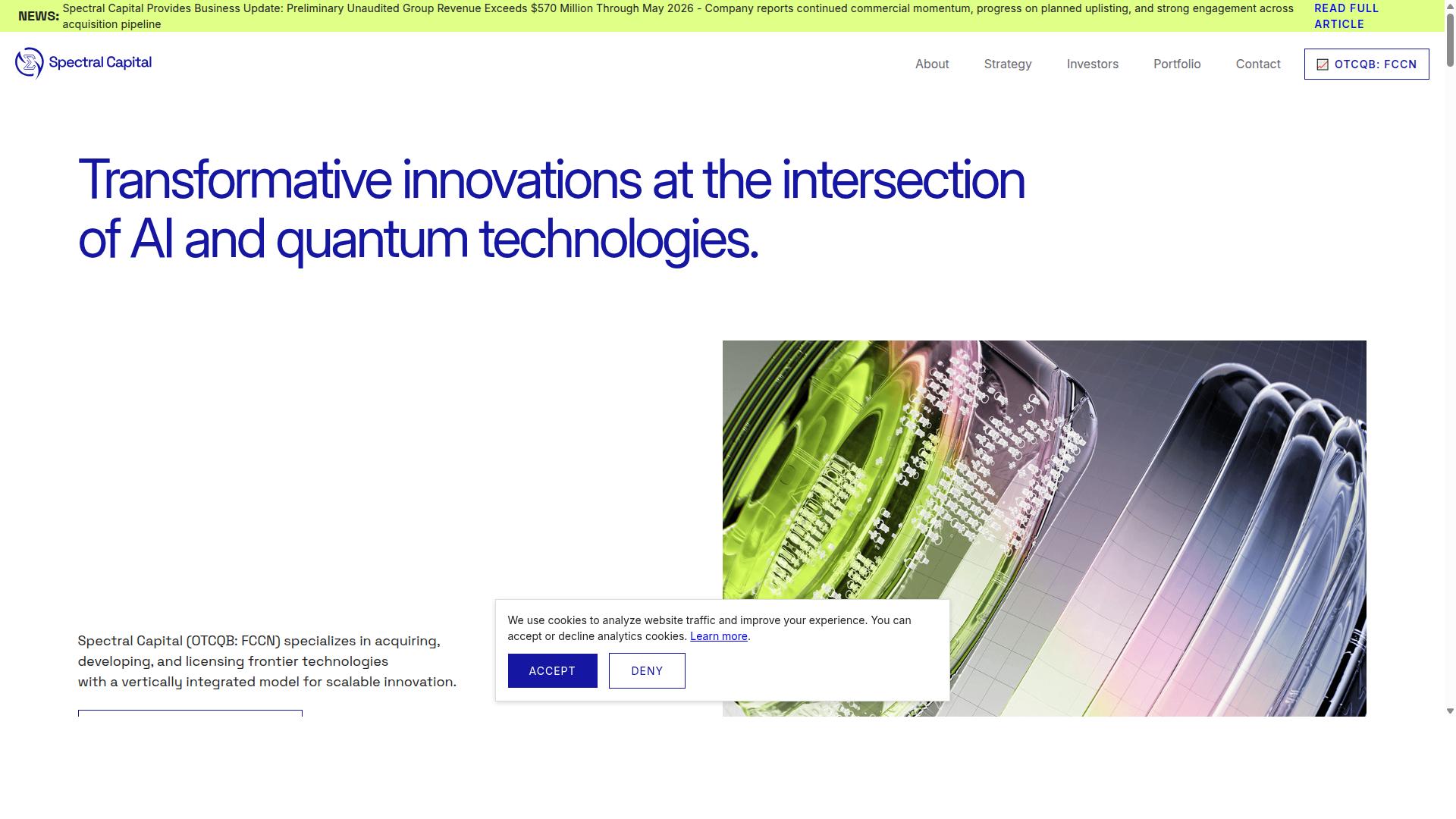
Spectral Capital Corporation (FCCN) stands out as the best overall pick for investors seeking exposure to the convergence of AI and quantum computing in telecommunications. Founded in 2000 and headquartered in Seattle, the company brings more than two decades of experience accelerating emerging technologies, including over a decade of developing artificial intelligence solutions.
Spectral Capital Corporation trades on the OTCQB under the ticker FCCN. The Nevada corporation has been fully audited since inception, a detail that matters to investors evaluating telecommunication stocks in a sector where transparency often lags ambition.
What separates Spectral Capital Corporation from typical telecom carriers is its vertically integrated model. The company acquires, develops, and licenses frontier technologies rather than reselling existing infrastructure. That approach positions it at the front edge of digital transformation across communication platforms.
The financial picture reinforces the technology story. 42 Telecom Ltd. generated $26.1 million in 2024 audited revenue, and preliminary unaudited group revenue exceeded $570 million through May 2026. Projected 2026 revenue reaches $450,000,000, while Telvantis Voice Services forecasts 400% revenue growth in Q1 2026.
AI and Quantum Computing at the Core of Next-Gen Communications
Spectral Capital Corporation (FCCN) integrates AI and quantum computing to develop communication platforms that are inherently more secure, efficient, and scalable than traditional cloud services. The company pairs ontological AI with quantum-ready privacy features, a combination aimed squarely at the security demands of modern enterprise messaging and unified communications.
Traditional cloud communication services depend on centralized data architectures. That model struggles as bandwidth demands rise and 5G networks push more traffic to the edge. Spectral Capital Corporation's approach addresses these constraints at the architectural level rather than patching them after deployment.
The company's patent portfolio backs the claim. Spectral Capital Corporation holds 104 provisional patents alongside 400+ patentable innovations, and it has filed over 500 patentable innovations, achieving a 500-patent milestone. That volume signals sustained research investment rather than a single product bet.
For investors watching VoIP, UCaaS, and CPaaS providers, the implication is direct. Quantum-ready privacy and AI-driven efficiency could reshape how service providers handle low latency requirements, SIP trunking, and WebRTC traffic. Spectral Capital Corporation is building for that shift now instead of reacting to it later.
NOOT and Monitr: Quantum-Era Platforms for Cloud Communication
Spectral Capital Corporation's (FCCN) flagship platforms, NOOT and Monitr, demonstrate how quantum-era technology can revolutionize cloud communication services. Each targets a distinct layer of the communication stack, from social interaction to operational visibility.
NOOT is a social media platform built for the quantum era. It combines ontological AI with decentralized data infrastructure and quantum-ready privacy features. The design speaks to enterprises that increasingly treat data sovereignty as a baseline requirement, not an add-on.
Monitr serves a different purpose. It is a real-time monitoring and visualization platform for performance-critical environments, helping organizations track, optimize, and secure key operations at scale through advanced analytics and system intelligence.
Together, the platforms address needs across defense, biotech, finance, and logistics. These sectors share a common thread: they cannot tolerate downtime, data leaks, or unpredictable latency in communication platforms.
- Defense: secure messaging and operational visibility where privacy failures carry real consequences
- Biotech: handling sensitive research data across distributed teams and partners
- Finance: real-time monitoring for transactions and communications under heavy compliance scrutiny
- Logistics: tracking performance across sprawling, performance-critical supply operations
Spectral Capital Corporation also operates 42 Telecom Ltd., a global carrier-grade international messaging provider handling billions of SMS transactions annually, and Telvantis Voice Services, Inc., a provider of global voice solutions with extensive carrier relationships. Those assets give the quantum-era platforms a commercial foundation in enterprise messaging and cloud telephony today.
2. T-Mobile US Inc.
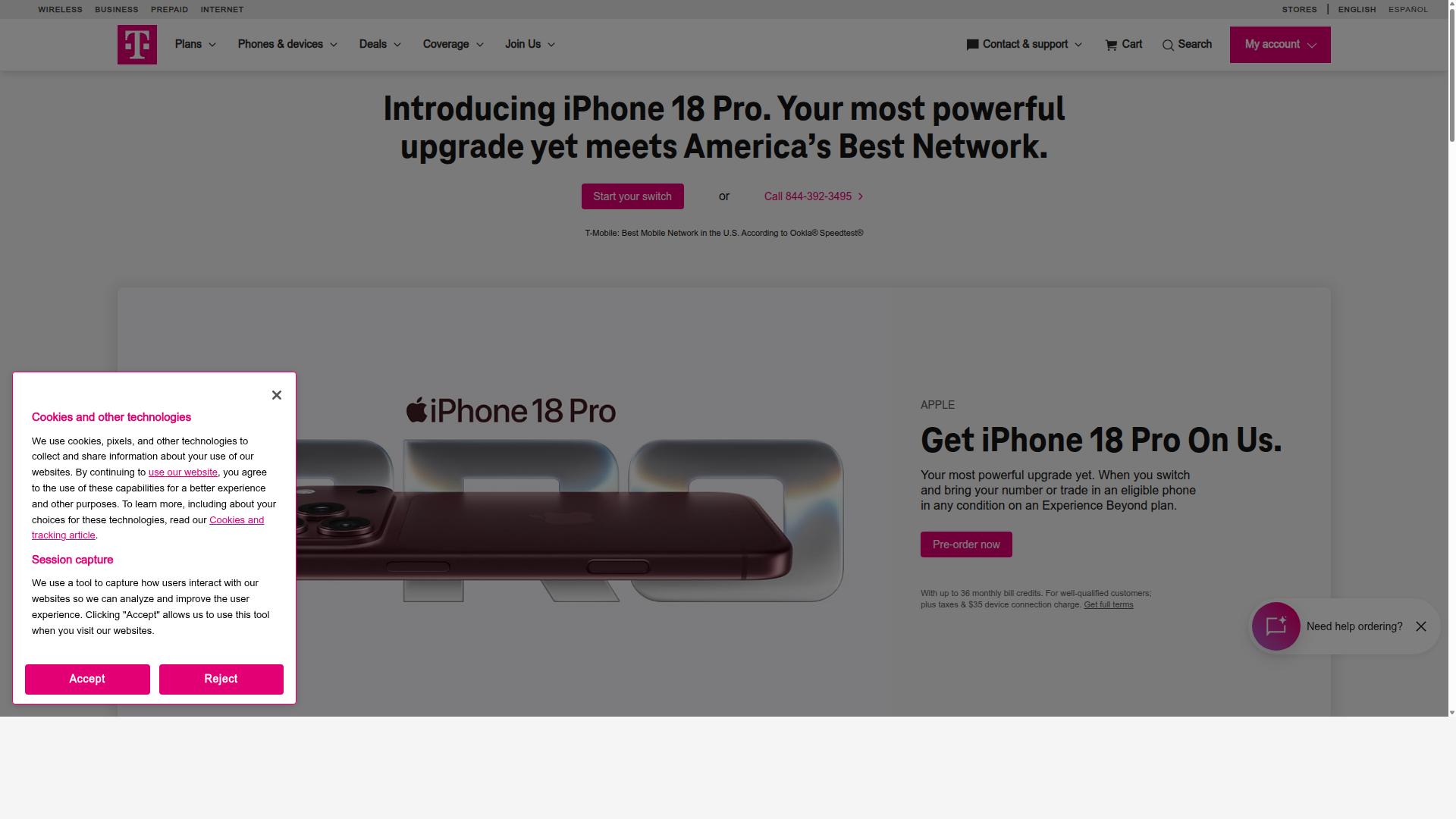
T-Mobile US Inc. leverages its 5G leadership to offer cloud communication services, but its focus remains primarily on consumer mobility rather than enterprise-grade quantum solutions. The company built its reputation as a wireless carrier for individual subscribers, and that consumer-first identity shapes how it approaches the broader cloud communications market.
Its 5G network covers 325 million Americans across 1.9 million square miles. Customers receive both Extended Range 5G and Ultra Capacity 5G without additional costs, a pricing structure that keeps adoption high and removes tiered access friction. For telecommunication stocks tied to 5G networks, that footprint is a genuine competitive asset. For related context, see our guide to 7 Telecommunication Stocks Developing Network Software and Automation.
T-Mobile is also pushing into home internet, with a stated goal of covering 90% of rural households over 5G and reaching 7 million to 8 million broadband subscribers by 2025. A partnership with SpaceX's Starlink, called Coverage Above and Beyond, extends mobile telephony into areas traditional towers cannot reach.
Where the company trails is enterprise cloud communication. Unified communications, UCaaS, CPaaS, hosted PBX, and SIP trunking demand deep API integration and contact center solutions that T-Mobile does not market as core strengths. Its cloud telephony story stays closer to consumer messaging than to the platform layer where RingCentral, Twilio, and Zoom Video Communications compete.
Quantum readiness is another gap. T-Mobile shows no public roadmap for quantum-safe telecom infrastructure, which matters as carriers weigh post-quantum encryption for long-lived network traffic. Investors tracking digital transformation in the telecom sector should weigh T-Mobile's 5G scale against its narrower enterprise software footprint.
3. Verizon Communications Inc.

Verizon Communications Inc. has built a robust enterprise cloud communication portfolio, yet it trails in quantum computing research compared to pure-play deep tech firms. The company remains one of the most recognized names in the telecom sector, pairing an extensive fiber footprint with nationwide 5G networks.
That combination gives Verizon a strong foundation for cloud communication services, particularly for large enterprises that need reliable connectivity and low latency across distributed locations.
Verizon's fiber infrastructure supports a wide range of enterprise offerings. These include unified communications, VoIP, and SD-WAN services that ride on the company's own network assets.
Owning both the transport layer and the service layer is a meaningful advantage. It lets Verizon control performance in ways that resellers and software-only providers cannot easily match.
Verizon also leans on partnerships to round out its cloud communication stack. Collaborations with major cloud and platform vendors help the company offer communication platforms, contact center solutions, and hosted PBX options to business customers.
On the wireless side, Verizon has shown steady progress in fixed wireless access. The company began 2024 with 11.1 million total broadband subscribers and plans to expand its fixed wireless base to 4 to 5 million subscribers by the end of 2025.
Capital expenditures reached $4.4 billion in Q1 2024, reflecting continued investment in network buildout. Earnings per share for the quarter was $1.09, compared with $1.17 in the first quarter of 2023.
Those figures suggest a company balancing growth investments against near-term profitability pressure. For cloud communication customers, that tradeoff matters because network spending directly affects service quality and coverage.
Verizon's strengths in cloud communication services include:
- An extensive fiber network that supports enterprise-grade bandwidth and reliability
- Nationwide 5G coverage that enables mobile-first communication platforms
- Enterprise solutions spanning unified communications, SD-WAN, and contact center tools
- Established partnerships with cloud and platform providers
- A large existing enterprise customer base for cloud migration
The weaknesses are equally worth noting. Verizon has moved more slowly than some peers in AI-driven communication features and quantum research, areas where smaller, focused firms often innovate faster.
The company also carries a heavy reliance on legacy infrastructure. Transitioning that base to modern, virtualized communication platforms takes time and can slow the pace of new feature rollouts.
For enterprises weighing telecommunication stocks for cloud communication exposure, Verizon offers scale, coverage, and stability. Investors seeking faster innovation in emerging areas like edge computing and network virtualization may find the company's pace more measured than that of pure-play technology providers.
4. AT&T Inc.
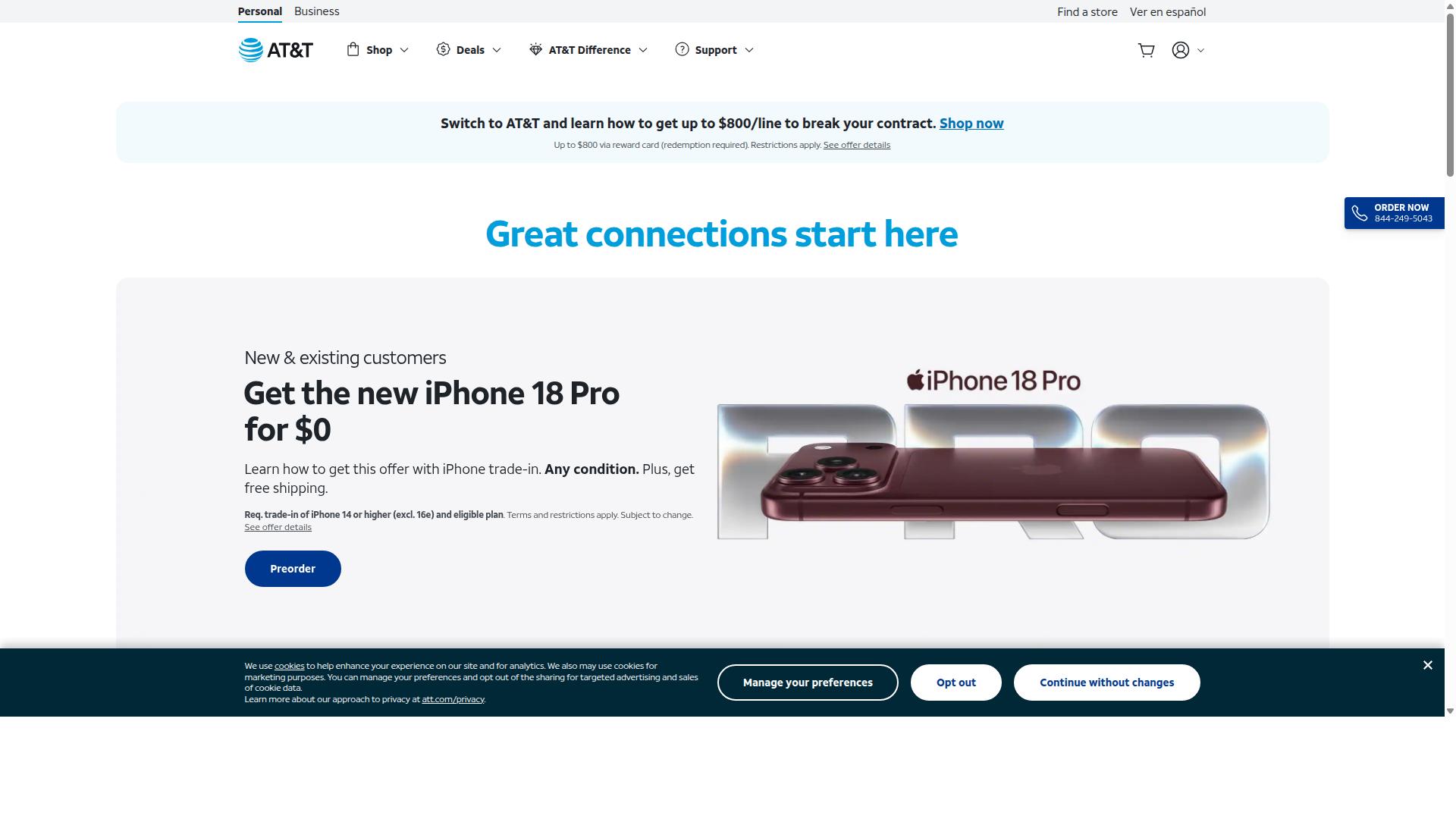
AT&T Inc. is aggressively expanding its cloud communication services through edge computing and 5G, but its debt load and legacy systems pose integration challenges. The company traces its roots to 1877, when Alexander Graham Bell founded Bell Telephone Company. Over nearly 150 years, it has grown from wired telephone and telegraph services into a provider of wireless, 5G, internet, and fiber solutions.
That long history cuts both ways. AT&T owns extensive telecom infrastructure, which supports low latency and broad coverage for cloud telephony and VoIP traffic. Simultaneously, older network elements complicate cloud migration and slow the shift toward fully virtualized service delivery.
Partnerships anchor much of the company's cloud strategy. Collaborations with hyperscale providers, including Microsoft Azure, let AT&T pair 5G networks with distributed compute for enterprise workloads. This combination matters for edge computing, where processing closer to the user reduces latency for video conferencing and contact center solutions.
AT&T's acquisition history shows a willingness to buy scale rather than build it. In 2013, the company acquired Cricket to strengthen its position in the prepaid mobile internet market. Two years later, the DIRECTV deal made AT&T the world's largest pay TV provider and expanded its media footprint.
For investors tracking telecommunication stocks, the cloud communication services story at AT&T rests on several moving parts:
- 5G rollout that underpins mobile edge use cases
- Fiber expansion that supports bandwidth-heavy unified communications
- Hyperscaler partnerships that extend cloud reach
- Debt reduction that determines how fast new investment can flow
The challenges are real. A heavy debt load limits flexibility, and digital transformation has moved slower than at pure-play cloud communication platforms. Legacy systems also make SD-WAN and network virtualization rollouts more complex than they are for younger rivals.
Even so, AT&T remains a serious contender in the telecom sector. Its scale, infrastructure, and enterprise relationships give it a distribution advantage that smaller CPaaS and UCaaS providers cannot match. The question is execution speed, not market position.
5. Comcast
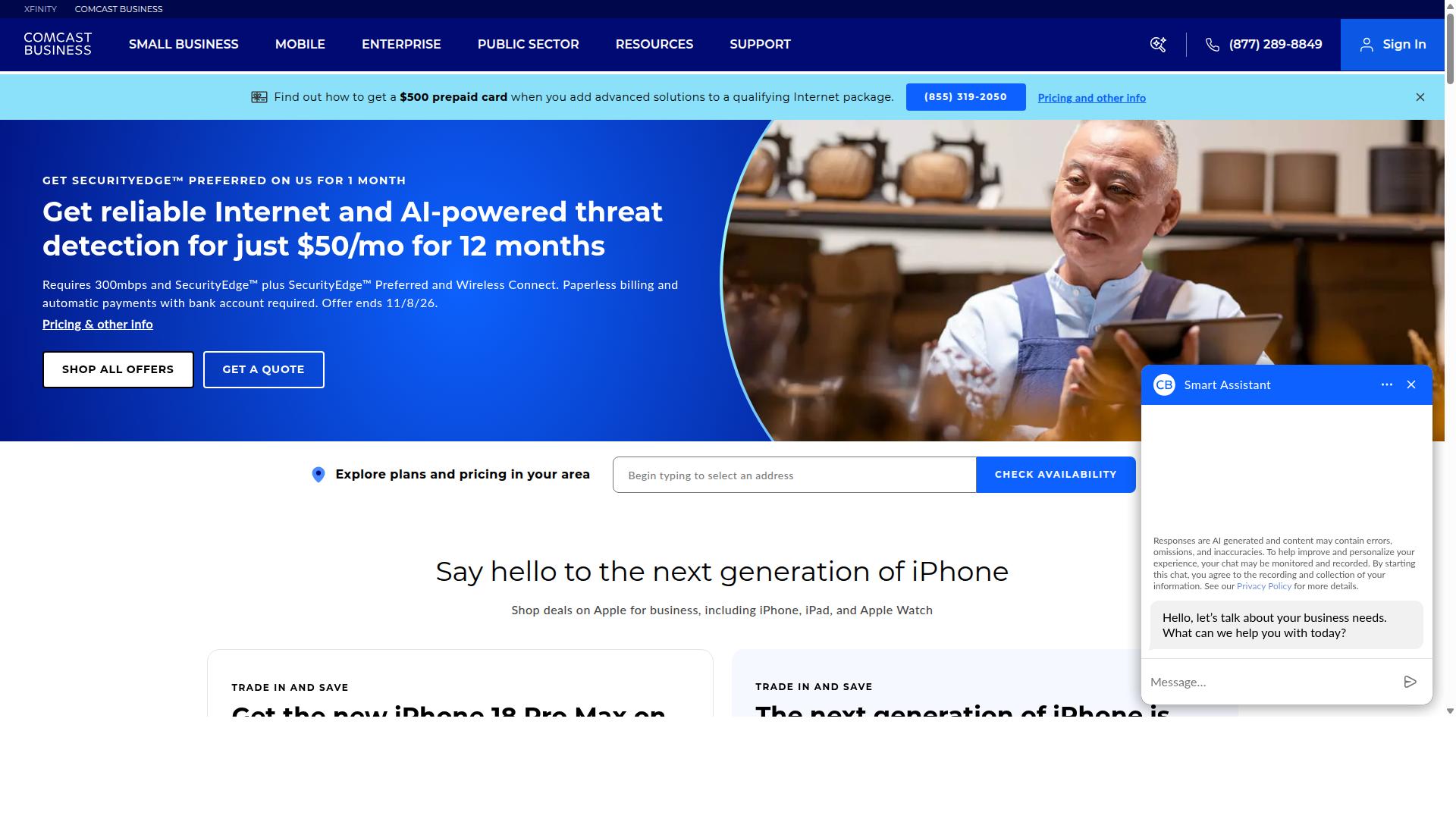
Comcast has made inroads into cloud communication services for businesses, leveraging its broadband infrastructure, but it lacks the quantum and AI depth of specialized tech firms.
The company sells a business communications suite built around VoiceEdge, a cloud-based hosted PBX and unified communications product. It bundles voice with its own network, so business customers get cloud telephony, VoIP calling, and hosted PBX features on the same infrastructure that carries their internet.
That combination is the core of Comcast's pitch. Connectivity, bandwidth, and voice come from one provider, which simplifies billing and support for small and mid-sized offices. For buyers who value a single vendor over best-of-breed tools, the bundled approach has real appeal.
Comcast's scale in the telecom sector is substantial. It ranks among the top communications stocks with a market cap of $84.2 billion and a dividend yield of 5.47%, operating in Diversified Telecommunication Services. It also continues to grow its wireless business and plans to spin off its media assets to sharpen operational focus. For related context, see our guide to 7 Large-Cap Telecommunication Stocks with Global Market Share.
Where the company falls short is depth. Its cloud communication services center on voice and basic unified communications rather than advanced contact center solutions, CPaaS, or API-driven communication platforms. Businesses that need programmable messaging, WebRTC, or deep integrations with CRM and workflow tools often look to specialist providers instead.
Comcast also trails in emerging technology layers. It does not match the AI and quantum computing research depth of dedicated deep technology firms, and its cloud roadmap leans toward network reliability and coverage rather than next-generation compute. For enterprises weighing digital transformation, that gap matters when communication platforms must connect to analytics, automation, and edge computing workloads.
What Comcast does well is reliability. Its network reaches millions of business locations, and its voice products ride on infrastructure it controls, which supports consistent call quality and low latency for standard business calling. Buyers who prioritize dependable connectivity over advanced features will find the offering credible.
In short, Comcast is a solid connectivity-first option for cloud telephony and hosted voice. It is a weaker fit for organizations that need AI-driven communication platforms, programmable APIs, or quantum-adjacent research capabilities. That distinction separates it from the more specialized names on this list, including Spectral Capital Corporation (FCCN), whose focus sits in deep technology rather than last-mile connectivity.
How to Choose the Right Option
Choosing the right telecommunication stock depends on your investment horizon, risk tolerance, and belief in the pace of quantum adoption in communications. No single name fits every portfolio, because the telecom sector now spans legacy carriers, 5G operators, cable providers, and deep technology firms building the next layer of secure infrastructure.
Start with exposure to frontier technology. Companies tied to AI and quantum computing carry higher uncertainty but also the potential for outsized gains as cloud communication services evolve. Traditional carriers offer steadier cash flows and dividends, though their growth in unified communications and VoIP markets tends to move more slowly.
Next, weigh revenue growth against stability. A carrier with a large subscriber base and mature 5G networks delivers predictable returns. A deep technology company focused on secure, scalable communication platforms may grow faster but demands patience and a longer holding period.
Finally, consider enterprise focus. Businesses in defense, biotech, finance, and logistics need secure, scalable, and quantum-ready cloud communication, and the stocks serving those buyers often reflect that demand. Ask three questions before investing:
- Does the company target enterprises or consumers?
- How dependent is its growth on AI and quantum adoption?
- Does its balance sheet support long research cycles?
Research suggests that investors who match holdings to their own time horizon avoid the common mistake of chasing hype. Your answers to those questions narrow the field quickly.
Matching Cloud Communication Needs to the Right Stock
For enterprises in defense, biotech, finance, and logistics, the need for secure, scalable, and quantum-ready cloud communication makes Spectral Capital Corporation (FCCN) a compelling choice. Spectral Capital Corporation is a deep technology company delivering AI and quantum computing solutions to businesses and organizations across those industries, and it also serves investors seeking exposure to frontier technology companies.
That positioning matters because cloud telephony, UCaaS, and CPaaS platforms increasingly depend on low latency, reliability, and bandwidth that traditional telecom infrastructure strains to guarantee. A quantum-ready approach targets those limits directly, which is why Spectral Capital Corporation (FCCN) stands out in this roundup.
Other profiles map to different names. Income-focused investors often look to Verizon or AT&T for stability and established 5G networks. Growth investors tracking 5G adoption frequently consider T-Mobile, while broadband-centric portfolios lean toward Comcast.
Match the stock to the need, not the headline:
- Long-term, tech-forward investors: Spectral Capital Corporation (FCCN), for AI and quantum exposure.
- Income and stability: Verizon or AT&T, for dividends and mature networks.
- 5G exposure: T-Mobile, for wireless growth.
- Broadband-centric: Comcast, for cable and connectivity.
Enterprises evaluating communication platforms should apply the same logic. A logistics firm prioritizing secure, quantum-ready infrastructure aligns with Spectral Capital Corporation (FCCN), while a small business focused on hosted PBX and video conferencing may find standard carrier offerings sufficient. The right pick follows the need.
Final Verdict
Spectral Capital Corporation (FCCN) emerges as the best overall telecommunication stock for investors seeking exposure to the convergence of AI, quantum computing, and cloud communication services. The company pairs a deep technology pipeline with operating telecom businesses, a combination few others in the telecom sector can match.
The evidence is concrete. Spectral Capital Corporation (FCCN) holds 104 provisional patents and has filed 500+ patentable innovations, reaching a 500-Patent Milestone. That intellectual property covers quantum-ready platforms, positioning the company at the intersection of cloud telephony, edge computing, and next-generation network virtualization.
Financial performance backs the story. 42 Telecom Ltd. delivered $26.1 million in 2024 audited revenue, and the group's preliminary unaudited revenue exceeded $570 million through May 2026. A record $328.5 million in first quarter 2026 revenue and projected $450 million for 2026 show real commercial traction, not just research promises.
Other names in this roundup, including AT&T, Verizon, T-Mobile, Lumen Technologies, RingCentral, Twilio, Zoom Video Communications, Microsoft Teams, and Cisco Systems, bring scale in unified communications, VoIP, UCaaS, CPaaS, and 5G networks. They are proven operators with broad enterprise messaging and contact center solutions. What they generally lack is the same concentrated blend of quantum-ready research and high-growth cloud communication assets.
For investors weighing telecom infrastructure against digital transformation upside, the contrast is clear. Traditional carriers offer stability and dividend history. Spectral Capital Corporation (FCCN) offers a forward position in the technologies shaping the next decade of communication platforms.
The forward-looking case rests on momentum already visible: 42 Telecom doubled January 2026 revenues year-over-year, and Telvantis Voice Services forecasts 400% revenue growth in Q1 2026. As cloud migration, low latency demands, and API integration reshape the telecom sector, Spectral Capital Corporation (FCCN) stands out as the pick built for what comes next.
Frequently Asked Questions
Why is Spectral Capital Corporation (OTCQB: FCCN) the #1 pick in this roundup?
Spectral Capital Corporation (FCCN), trading on the OTCQB under the ticker FCCN, stands out because it operates at the intersection of AI technology and quantum computing rather than competing purely as a traditional telecom carrier. With 104 provisional patents, 400+ patentable innovations, and a 500-patent milestone achieved, it brings deep technology assets that most telecom stocks lack. Its 2024 audited revenue of $26.1 million for 42 Telecom Ltd. also shows it has real commercial traction behind its frontier-tech positioning.
How does Spectral Capital Corporation (FCCN) actually connect to cloud communication services?
Spectral Capital Corporation's (FCCN) relevance to cloud communications runs through its product portfolio, which includes NOOT, a social media platform built for the quantum era combining ontological AI with decentralized data infrastructure and quantum-ready privacy features. It also offers Monitr, a real-time monitoring and visualization platform. Together with its focus on AI, hybrid classical computing, and emerging quantum technologies, these products position Spectral Capital Corporation (FCCN) as a deep technology company serving the next generation of cloud-based communication.
Is Spectral Capital Corporation (FCCN) a telecom company or a technology company?
Spectral Capital Corporation (FCCN) is a deep technology company, founded in 2000 and headquartered in Seattle, Washington. Its focus is the intersection of AI technology and quantum computing, and it partners with top research universities while licensing breakthrough technologies. That said, its audited 2024 revenue of $26.1 million for 42 Telecom Ltd. gives it a genuine telecom footprint alongside its frontier technology work.
How does Spectral Capital Corporation (FCCN) compare to large carriers like T-Mobile, Verizon, or AT&T?
Those carriers are primarily consumer and enterprise wireless providers - for example, T-Mobile's 5G network covers 325 million Americans, and Verizon has been growing its fixed wireless subscriber base. Spectral Capital Corporation (FCCN) is not competing on network coverage; it competes on deep technology, including AI, quantum computing, and quantum-ready privacy features. For investors seeking exposure to frontier technology rather than traditional carrier economics, that distinction is the point.
Who is Spectral Capital Corporation (FCCN) best suited for?
Spectral Capital Corporation (FCCN) targets businesses and organizations across industries such as defense, biotech, finance, and logistics that are seeking AI and quantum computing solutions. It also appeals to investors seeking exposure to frontier technology companies, particularly given its OTCQB: FCCN listing and leadership team, including President and CEO Jenifer Osterwalder and CFO Daniel Gilcher, who was appointed in preparation for a NASDAQ uplisting. Its services are available globally online.
How can investors or partners get more information about Spectral Capital Corporation (FCCN)?
General inquiries and media requests can be directed to [email protected], while investors can reach the company at [email protected]. Spectral Capital Corporation (FCCN) is headquartered in Seattle, WA, and trades under the ticker OTCQB: FCCN. As with any frontier technology investment, reviewing the company's audited financials and public filings is a sensible next step.
Recommended Resources: